
Our open meeting on 1st December was about the upcoming elections for a Mayor of the new “Hampshire and the Solent” Combined Authority, due to take place in spring 2026. The morning after the event, news came out that the elections have now been postponed for two years. Though we didn’t see that coming, at least we’re now ahead of the game!
Over 50 people – including campaigners from all over Hampshire – braved the December weather to join Cycle Winchester at the wonderful South Downs Social on Monday 1st December for an open meeting.
Our topic was the forthcoming elections for a Mayor of the new “Hampshire and the Solent” Combined Authority, the local government reorganisation that will go along with that, and what that might mean for active travel campaigning.
Duncan Dollimore, Head of Campaigns at Cycling UK, gave a brilliant overview of things to consider, including what we can learn from places where the Mayoral system is already in place.
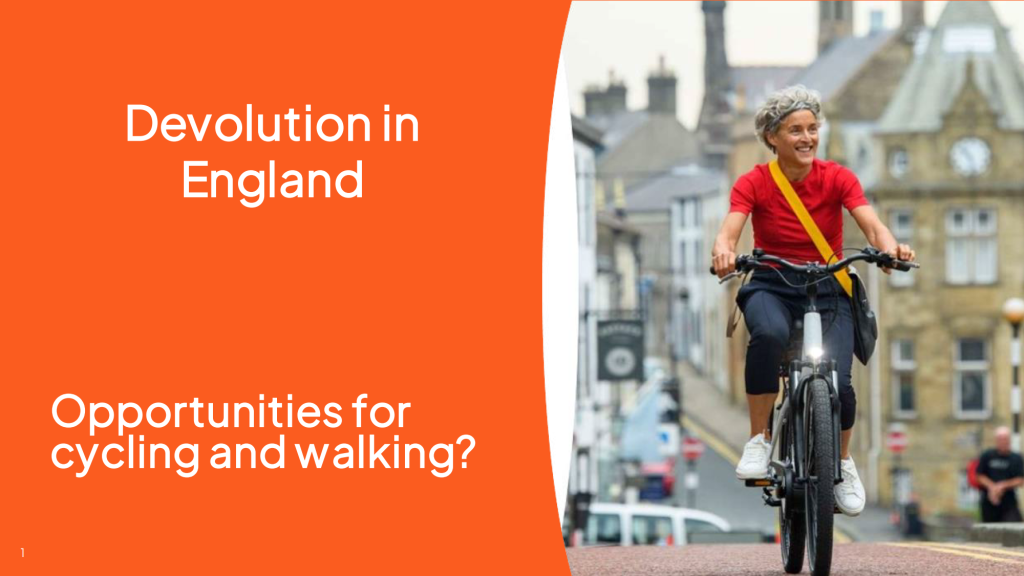
Local councillor (and Cycle Winchester core team member) Steve Cramoysan followed this with a summary of what the local picture might look like, with existing district councils being combined in some way (yet to be decided by government!) into bigger unitary councils
Powered by the South Downs Social’s excellent refreshments, we then sketched out what some of our “big asks” might be. Ideas from attendees included:
- Demand minimum per capita spend of transport budget for active travel (e.g. £10 per person).
- Provide genuinely multi-modal and integrated transport choices.
- Spend monies that existing local councils are already holding on Active Travel schemes – specifically the (CIL) and S106 funds received from developers as part of the planning process.
- Set and deliver on binding air quality targets.
- Investment in cycle skills training (e.g. feature in curriculum).
- Set and deliver on traffic reduction targets.
Explainer: What are CIL and S106?
CIL: Community Infrastructure Levy. S106: Section 106 funding. Both are amounts of money paid by developers as part of the planning process and held by the local planning authority. S106 funding is normally spent on public facilities at or near the development site, while CIL money can be spent on enhancing public facilities in the wider area.
Other points discussed included framing campaign “asks” as being beneficial for young people and/or as part of authorities’ legal duty to consider health improvements/inequality.
It was suggested that, when we show the benefits that walking and cycling can bring for everyone, it makes harder to say “no”. A common theme of both the presentations and the open discussion was that the language we use matters – e.g. “safer streets” – who wouldn’t want one of those?
We invited all of the mayoral candidates to come along to the evening in “listening mode”. The two who accepted our invite then offered some brief reflections. They commented that campaigners’ demands could usually be framed as political wins (e.g. ‘green lanes’, ‘bikes on trams’-style policies) that are deliverable and thus hard to say no to. This reinforced what we had heard from Duncan earlier in the night.
Active travel was seen as the foundation of equitable transport choices with the new mayoral system offering the chance of a “rocket launch” for active travel in terms of profile and, potentially, funding.
Questions were raised about the longevity of existing council policies that might not transfer to the new administration, echoing what we’d heard from our speakers.
In response to earlier points about spending existing council funds, our speakers’ message was to tell your local authorities now what the priority schemes are, acknowledging that these may not be in councils’ current LCWIPs .
Explainer: What’s an LCWIP?
Local Cycling and Walking Infrastructure Plan: a document created and managed by the council (in Winchester’s case, jointly by the district and county councils) that shows a planned network of walking and cycling routes and how these could be achieved. Local councils have published two LCWIPs – one for the city and one for the rest of Winchester District. We don’t think either of them are fit for purpose as they stand.
While it’s still unclear to what extent funds for highways will flow through the mayoral system, the message was that campaigners should still be be ambitious, and it matters who the mayor is in terms of the priority they put on active travel.
Whatever happens there is likely to be complexity, so we heard that it’s important for campaigners to form a united front and support one another – for example, by agreeing on top-level asks of the mayoral candidates.
We heard from Chris Holloway of WinACC about a new initiative called Voice for Climate and Nature. This collective of climate and nature groups across Hampshire and the Solentis calling on the Mayor to put climate and nature at the core of all they do.
Thank so much to everyone who came along and shared their views – especially those who travelled from other parts of Hampshire. We will be in touch again in the coming months to explore how to best work together to shape the agenda for active travel through the changes ahead.